

Why water filtration?
Texas has a water problem. Here’s what you should know about it.
You can’t trust the tap.
Municipal water treatment works…up to a point.
In Texas, water is consistently rated among the hardest in the country. That means it’s saturated with dissolved calcium and magnesium, even after passing through a treatment facility. Those minerals can calcify your faucets, leave residue on your dishes, and wear down your appliances over time.
But hardness isn’t the only problem.
According to the Environmental Working Group (EWG), multiple contaminants have been detected in Austin’s water above recommended health guidelines, including disinfection byproducts. These are chemicals that form when the chloramine (a chemical used in water treatment) reacts with organic matter in the source water.
Here are just a few examples of what was recently found in the water in Austin:
Chromium, a known carcinogen, was detected at 8.7 times above the EWG’s health guideline. Multiple PFAS compounds—what some people call “forever chemicals”—were also found, including PFOS and PFHxS.
Total trihalomethanes were detected at 209 times above the guideline. Haloacetic acids came in at 471 times above it. Both are linked to cancer with long-term exposure. Both are perfectly legal under current federal standards.
You can look up the full breakdown at ewg.org/tapwater. But you get the picture.
hard water affects…
-
Hard water can cause dry skin. That’s because the minerals in hard water can disrupt your skin’s natural barrier, leaving it dry, itchy, or prone to irritation.
The same goes for your hair. Hard water can coat the hair shaft with mineral buildup, making it harder to lather and rinse, and leaving it brittle, dull, and prone to breakage.
-
Every appliance that touches water—your water heater, dishwasher, washing machine, and faucets—has a tolerance for hardness. Exceed it long enough, and you may be looking at early replacement.
The long-term savings from a filtration system are real, and they compound over time.
-
In an ideal world, you’d trust the source and never think twice about it. But if you want real agency over your own supply, you’ve got to take it.
The best insurance policy is treating your water right before it enters your house, so you know it’s handled. You don’t have to trust that to whoever's on the other end of the pipe.
How Does whole-home Water filtration work?
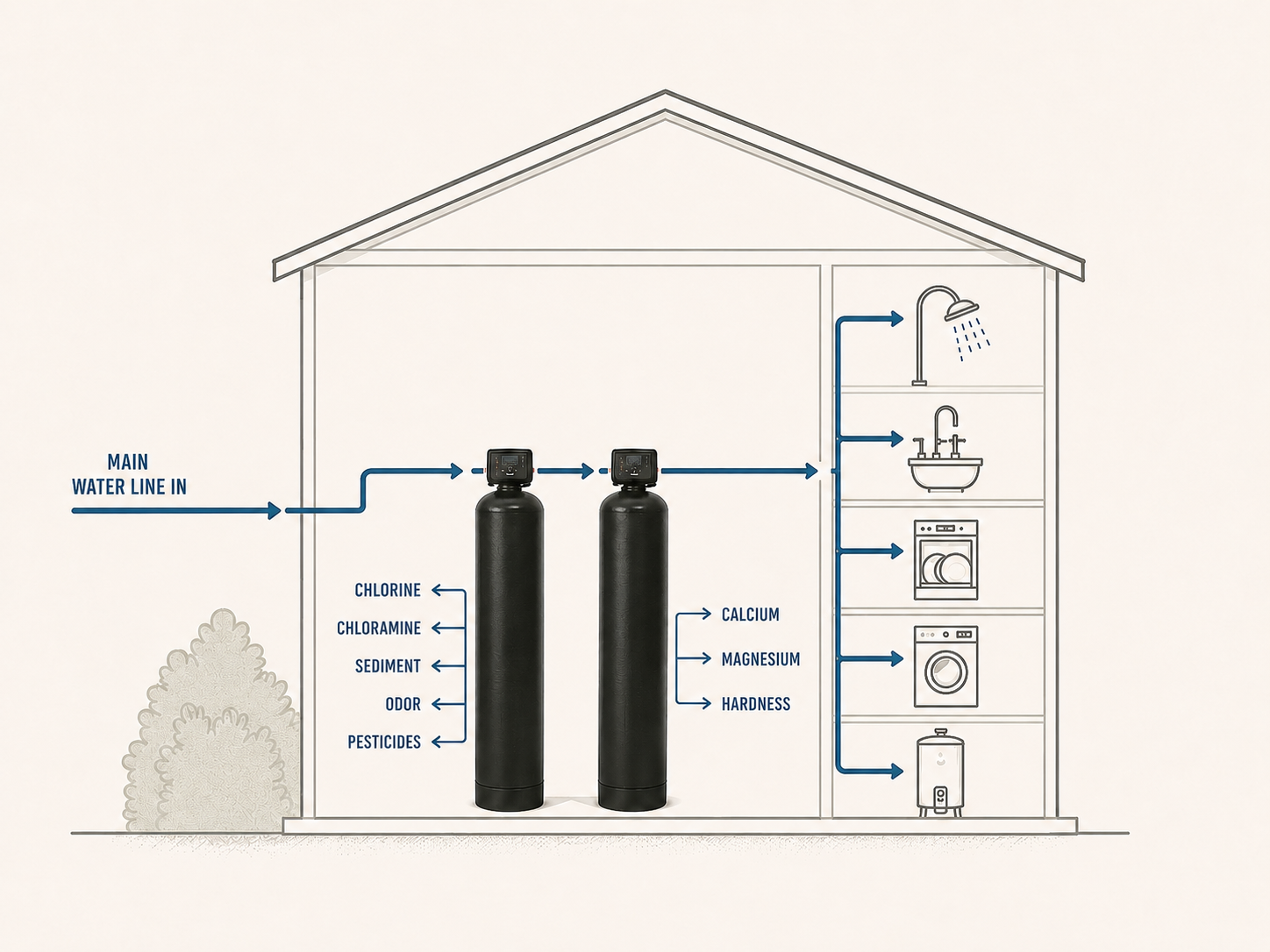
A whole-home system connects to your main water line where it enters the house—so every tap, shower, and appliance receives clean water. The system is made up of two main parts:
(1) The catalytic carbon tank
This filters your water. It runs your water through activated carbon media, which absorbs chlorine, chloramine, volatile organic compounds, pesticides, and all the foul-smelling, nasty chemical byproducts.
(2) The resin tank
This softens your water. A salt-based ion exchange process pulls the hard minerals—calcium and magnesium—out of the water by swapping them for sodium ions. Unlike calcium and magnesium, which bind to surfaces and form scale, sodium stays dissolved and passes through harmlessly. You refill this tank with salt periodically, and the system regenerates itself automatically.
Together, these tanks provide the most complete solution available for residential water treatment.

Want to know what’s in your water?
We offer free water tests. We come to you, run the test on-site, and walk you
through the results—with no obligation to buy anything afterward.